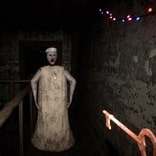
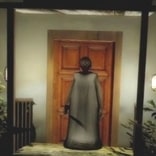
You drop into water up to your knees beneath the stairwell, feeling along the tunnel wall for the rusty boat you spotted through a grate ten minutes ago, when a second set of footsteps starts overhead — heavier than before, dragging one boot like it never used to. That is the moment Granny: Chapter Two stops feeling like the house you escaped the first time and starts feeling like somewhere new entirely. The sequel moves the fight for survival out of a single building and into a five-floor sprawl running from a flooded sub-basement to a guard tower on the roof, and it hands the job of catching you to two captors instead of one.
| Genre |
Horror survival, stealth escape |
| Setting |
Five-floor house, sewer sub-basement, rooftop guard tower |
| Threats |
Granny, Grandpa, the Sewer Monster, a spider on higher difficulty |
| Escape routes |
Front door, rusty boat through the sewer gate, guard tower rooftop |
| Difficulty levels |
Practice, Easy, Normal, Hard, Extreme |
Grandpa Joins the Hunt in Granny: Chapter Two
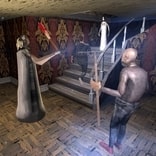
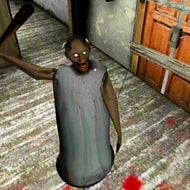
Granny is still fast, still sharp-eared, still the one who comes running the instant a floorboard creaks under your foot. Grandpa is a different problem. He moves slower, but he hits harder, and he carries a shotgun that ends a run in one shot if he lines it up. The two of them patrol the same five floors at the same time, which means a hiding spot that was safe from Granny an hour ago might now sit directly in Grandpa’s path.
What trips up new players fastest is treating Grandpa like a second Granny. He isn’t. His hearing is worse than hers, so noise that would send Granny sprinting across the house barely registers with him, and that makes him harder to bait away from a doorway you need to get through. Veteran players describe him as the one who ruins a clean run, because you can plan around Granny’s hearing but you can’t always predict where Grandpa is simply standing.
By the time you have mapped the ground floor, you start hearing both of them at once — her fast footsteps on one side of the house, his slow ones on the other — and the game stops being about avoiding a single threat and starts being about triangulating two.
The Sewer Monster and the Rusty Boat Escape
The sub-basement floods into a sewer, and down there sits an old, rusted boat next to a gate that has to be opened before the boat does you any good. Getting the boat running and the gate open is one of the more involved escape routes in Granny: Chapter Two, and it is also where the Sewer Monster lives — an octopus-like creature that patrols the flooded tunnels and behaves nothing like Granny or Grandpa upstairs.
Players who try the sewer route for the first time usually get caught off guard by how differently movement works down there. Wading through water is loud, slow, and leaves you exposed for longer stretches than sneaking across carpet upstairs. Completionist players who want to see every part of the map tend to gravitate to this route specifically because it forces them to learn the sewer layout the front-door strategy never touches.
Once the gate is open and the boat is running, the escape itself is short — but reaching that point safely, past the Sewer Monster, is the actual challenge the route is built around.
The Guard Tower Rooftop Route
The rooftop escape starts with a side room and a barred door. Open the bar, and it leads out onto the roof near the guard tower, a route that barely existed in the original house and gives Granny: Chapter Two a genuinely different rhythm from climbing straight to a locked front door.
This path rewards players who have already learned the upper floors well, since reaching the side room usually means crossing territory Granny and Grandpa both patrol. Early attempts often fail here simply from poor timing — sprinting for the bar the moment a hallway looks empty, without waiting to hear which direction footsteps are heading next.
Open-world explorers who like scouting every option before committing tend to favor this route because it offers a clear vantage point once you’re up there, something none of the ground-floor paths give you.
Bear Traps and the Creaking Floor Problem
Drop something on the floor, or step on a board that creaks, and Granny comes running toward the sound. That single mechanic shapes almost every decision you make in the house, from which items you dare pick up near her to which rooms you cross at a crouch instead of a walk.
Bear traps scattered through the house punish careless movement even when neither captor is nearby. Step in one and you’re both injured and loud, which usually draws Granny in from wherever she was patrolling. Players talk about “the loop” — kiting Granny by making noise on one side of a room and slipping out the other — as the core skill the whole game is built around, and bear traps exist specifically to make that loop riskier than it looks.
Early in the game you’ll trip a trap by accident at least once. By the time you reach the upper floors, most players have learned to test suspicious tiles before crossing them.
The Spider You Only Meet on Hard and Extreme
Granny: Chapter Two keeps five separate difficulty levels, and the roster of threats actually changes between them rather than just making the existing ones faster.
- Practice — no real threat, used to learn the map layout.
- Easy — Granny and Grandpa patrol, but the spider and crow are absent.
- Normal — the standard experience most players settle into.
- Hard — the spider appears, adding a threat that behaves nothing like the other two.
- Extreme — every threat is faster and less forgiving of mistakes.
The spider is the one players bring up most when comparing difficulty settings, since it doesn’t patrol like Granny or Grandpa — it waits, which means the danger it poses depends entirely on whether you know to check for it before reaching into a cabinet or crawlspace it favors.
Speedrunners who chase fast completion times almost always play on Easy specifically to remove the spider from the equation, since its unpredictable placement adds a variable that’s hard to plan a route around.
Five Days, Five Knockouts: How a Run Ends
The game gives you five in-game days to escape. Get caught, and the day ends immediately rather than the run itself — you wake up again, a day further along, with Granny and Grandpa reset to their starting patrol but the clock quietly ticking against you. Get caught on the fifth day, and that’s the actual game over.
This is the part of Granny: Chapter Two players debate the most. Some find the five-day cushion generous, giving room to learn the house through trial and error. Others find losing a day to a single bad noise frustrating, especially on runs where an item needed for the front door spawned somewhere inconvenient — spawn locations shift between playthroughs, and that randomness is a genuinely divisive point in forum threads about the game.
First-time players tend to burn through most of their five days just learning where items and locks are. Return players who already know the map treat those same five days as a real time limit for a fast escape.
Questions Players Ask About Granny: Chapter Two
- How do you get past Grandpa without waking Granny? Grandpa reacts to less noise than Granny does, so the trick is testing floor tiles slowly near him while saving faster, riskier movement for parts of the house where only Granny is nearby.
- Can you actually escape through the sewer with the boat? Yes — the boat near the sub-basement gate is a legitimate escape route once the gate mechanism is opened, though reaching it means dealing with the Sewer Monster in flooded tunnels the whole time.
- Does the spider show up on every difficulty? No, the spider and crow are absent on Easy and only start appearing from Hard upward, which is why players optimizing for speed usually avoid the higher settings entirely.
Granny: Chapter Two earns its place as a sequel by refusing to just reskin the original house — dropping Grandpa’s shotgun into the mix, opening up the sewer route past the Sewer Monster, and letting the guard tower rooftop become a genuine third way out changes the math on every single room you cross.