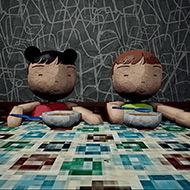
Family Secrets 1: Empty Plate looks, in its opening minutes, like a small domestic errand: a phone call from a busy mother, a promise to be back soon, an older brother left holding the house together. It plays like something else entirely. Once the door closes behind Miko’s mother, the game stops being about babysitting and starts being about how quiet a home can get when nobody’s coming back on schedule, and by the time the first real scare lands, the ordinary framing has already curdled into something closer to dread.
Family Secrets 1: Empty Plate Starts With an Ordinary Phone Call
Miko is the one who picks up the phone, and the setup couldn’t be more mundane — his mother has to leave for work for several days, and he’s now responsible for his younger sister, Jun, until she’s back. There’s no tutorial popup explaining a horror mechanic waiting around the corner. The game plays it straight for long enough that the shift, when it comes, feels earned rather than telegraphed.
If you’re wondering how long that shift takes to fully land: the whole experience runs about thirty to forty minutes, short enough to finish in a single sitting, which fits its framing as a compact horror episode rather than a sprawling story. There are no chapters to grind through and no save-scumming required — you start the call, and the game carries you through to whatever ending you land on.
Controls stay just as minimal as the pacing. Movement is WASD, interacting or skipping dialogue is E, the flashlight toggles on F, and ESC pauses — nothing more layered than that, because the game isn’t interested in giving you systems to master.
Miko’s Job Isn’t Babysitting, It’s Everything
Caring for Jun becomes the emotional center of the run rather than a background objective. Two small, specific moments do most of that work: a feeding scene where Jun looks up happily once fed, and a hand-washing moment where she thanks Miko directly for taking care of her. Neither is dramatic on its own, but both land harder than they should because so little else in the house offers that kind of warmth.
That’s also where the horror gets its footing — not from a monster jumping out, though the game does include a handful of genuine jump scares, but from the growing gap between what a child needs and what one child can actually provide for another. Players drawn to narrative-first horror tend to single this dynamic out as the part that sticks with them longest, more than any individual scare.
There’s no combat here and nothing to collect or upgrade — if you’re asking whether Family Secrets 1: Empty Plate has any kind of fighting or item system, it doesn’t, and that absence is deliberate. The tension comes entirely from exploring rooms, checking objects, and watching the story move forward on its own fixed track rather than branching based on player choice.
What the House Quietly Tells You Before Miko Does
The overdue notice from the electric company is one of the first hard signs that something is wrong beyond a missed phone call — a torn envelope among unopened mail that explains, without a single line of dialogue, why the house starts behaving strangely once the lights are involved. Jun and Miko’s shared room is where a lot of the game’s quieter character work happens, small enough that every object in it feels deliberately placed rather than set dressing. The character models themselves carry the same restraint — simple, low-detail textures that still manage to read as dirty and neglected without the game ever spelling it out, which is the kind of detail you only clock once you’ve spent thirty minutes in these two kids’ company.
An Ending That Splits the Room
Somewhere past the midpoint, a father figure enters the story in a way that recontextualizes a lot of what came before, and the game doesn’t slow down to explain the connection — it just lets the implication sit there. A chocolate cake that surfaces late in the story becomes, by a wide margin, the single detail players argue about most once the credits roll, with plenty of disagreement over what it’s actually meant to represent.
That ambiguity is the most divisive part of Family Secrets 1: Empty Plate for exactly the reason it’s also praised: the game commits to a fixed ending rather than branching choices, so everyone finishes with the same images but not the same read on them. Some players walk away certain about what happened to Jun and when; others leave openly unsure whether events played out in the order they appeared to.
What isn’t in dispute is the emotional weight of it. Family Secrets 1: Empty Plate closes on Jun rather than on any twist for its own sake, and it’s her small, specific gestures — the happy look over a plate of food, the quiet thank-you at the sink — that people still bring up long after they’ve forgotten the exact shape of the scare that got them.